Zojirushi Micom vs Neuro Fuzzy vs IH Rice Cooker: Real Differences Explained
Choosing between Zojirushi Micom, Neuro Fuzzy, and IH rice cookers can be confusing. Many guides oversimplify these technologies, which often leads to the wrong buying decision. That’s why this guide, “Zojirushi Micom vs Neuro Fuzzy vs IH Rice Cooker: Real Differences Explained,” is here to simplify your choice and show the real differences clearly.
After analyzing how these systems actually work and how they perform in real kitchen use, one thing becomes clear:
These are not just simple upgrade levels, they improve different parts of the rice cooking process.
This guide explains the real differences, so you can make the right decision based on your needs.
Quick Answer (Simple Comparison)
| If you want | Best choice |
|---|---|
| Best value | Micom |
| Better texture control | Neuro Fuzzy |
| Best overall performance | IH |
Understanding Zojirushi Micom vs Neuro Fuzzy vs IH
A common misconception is:
Micom → Neuro Fuzzy → IH (step-by-step upgrade)
This is not accurate.
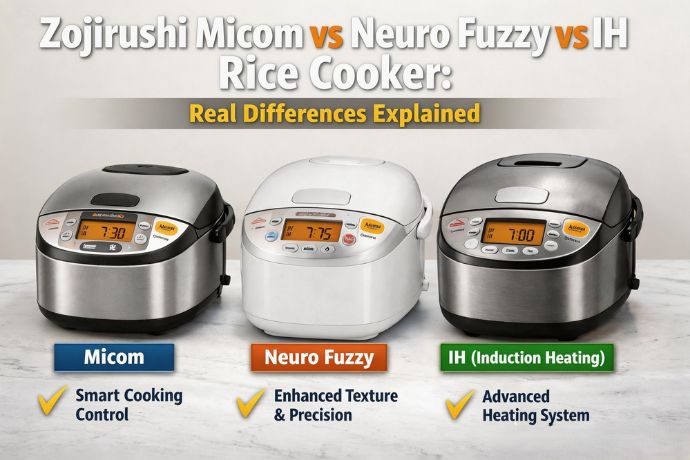
- Micom refers to microcomputer-controlled cooking
- Neuro Fuzzy is a more refined version of Micom logic
- IH (Induction Heating) is a different heating technology
Important:
Neuro Fuzzy models are part of the Micom category, while IH models combine Micom + advanced heating system
What is a Zojirushi Micom Rice Cooker?
Micom (microcomputerized) rice cookers use a built-in chip to automatically adjust cooking time and temperature.
Instead of a simple on/off heating system, it:
- Controls soaking, cooking, and steaming stages
- Adjusts heat dynamically
- Maintains consistent results
Real-world performance
In everyday use, Micom rice cookers produce reliable and consistent rice without requiring manual adjustments.
Best for:
- Daily rice cooking
- Beginners
- Budget-conscious users
For most households, Micom already delivers excellent results.
What is Zojirushi Neuro Fuzzy?
Neuro Fuzzy is an advanced version of Micom technology.
It improves the cooking process by:
- Making more precise adjustments
- Focusing on texture control
- Adapting better to different rice types
Real-world performance
You will notice:
- More consistent texture
- Better handling of brown rice and mixed grains
- Improved cooking accuracy
Best for:
- Frequent rice cooking
- Users who care about texture
- Cooking different rice varieties
What is IH (Induction Heating)?
IH stands for induction heating, which is a major hardware upgrade.
Instead of using a heating plate, IH:
- Heats the inner pot directly
- Responds quickly to temperature changes
- Distributes heat more evenly
Why this matters
Rice cooking depends heavily on heat control across stages like soaking, simmering, and steaming.
IH improves all of these stages.
Best for:
- Frequent use
- High consistency
- Premium performance needs
Micom vs Neuro Fuzzy vs IH (Detailed Comparison)
| Feature | Micom | Neuro Fuzzy | IH |
|---|---|---|---|
| Technology | Microcomputer | Advanced Micom | Induction + Micom |
| Heating | Standard plate | Standard plate | Induction |
| Control | Good | Better | Best |
| Texture | Good | Refined | Excellent |
| Consistency | Reliable | More precise | Most consistent |
| Speed | Moderate | Moderate | Faster |
| Price | Lower | Mid-range | Higher |
Real-World Performance Comparison
In actual kitchen use, the differences become clearer:
- Micom performs very well for standard white rice and daily meals
- Neuro Fuzzy improves texture and works better with different rice types
- IH delivers the most even cooking, especially for brown rice and mixed grains
If your cooking is simple, Micom is enough
If you want better texture, Neuro Fuzzy or IH shows noticeable improvement
Cooking Time & Efficiency
- Micom → Slightly slower but energy-efficient
- Neuro Fuzzy → Similar speed with better control
- IH → Faster heating but may use more electricity
IH models are faster, but Micom models are more efficient for everyday use
Which One Cooks the Best Rice?
- Micom → Great everyday rice
- Neuro Fuzzy → Better texture control
- IH → Best overall consistency and performance
From a technical standpoint, IH provides the highest quality results.
Is Neuro Fuzzy Better Than Micom?
Yes — but only in specific situations.
If you:
- Care about rice texture
- Cook different rice types
Then Neuro Fuzzy is a better choice.
Otherwise:
Micom is already sufficient for most users.
Is IH Better Than Neuro Fuzzy?
This comparison depends on what you value:
- Neuro Fuzzy improves cooking logic
- IH improves heating performance
IH usually delivers better overall results
But Neuro Fuzzy offers better balance for many users
Common Buying Mistakes
Avoid these common mistakes:
- Thinking Neuro Fuzzy uses a different heating system
- Assuming IH is necessary for everyone
- Overspending without understanding actual needs
The best choice depends on usage, not just features.
Which One Should You Choose?
Ask yourself:
- How often do you cook rice?
- Do you notice texture differences?
- Are you willing to pay more for small improvements?
Simple decision guide:
- Occasional use → Micom
- Regular use → Neuro Fuzzy
- Heavy use / best results → IH
Final Recommendation by Use Case
- For students or small families → Micom
- For regular home cooking → Neuro Fuzzy
- For frequent or high-demand use → IH
Final Verdict
The real difference is simple:
- Micom → Smart everyday option
- Neuro Fuzzy → More refined texture control
- IH → Best heat performance
Choosing the right one depends on your cooking habits, not just technology.
FAQ
What does Micom mean?
Micom stands for microcomputerized cooking, where a chip controls time and temperature automatically.
Is Neuro Fuzzy a type of Micom?
Yes, it is an advanced version of Micom with better cooking adjustments.
What does IH mean in rice cookers?
IH stands for induction heating, which heats the inner pot directly.
Is IH worth it?
IH is worth it for frequent use and maximum consistency.
Is Neuro Fuzzy worth it?
It is worth it if you care about rice texture and variety.
Which one is best overall?
IH offers the best performance, while Micom offers the best value.