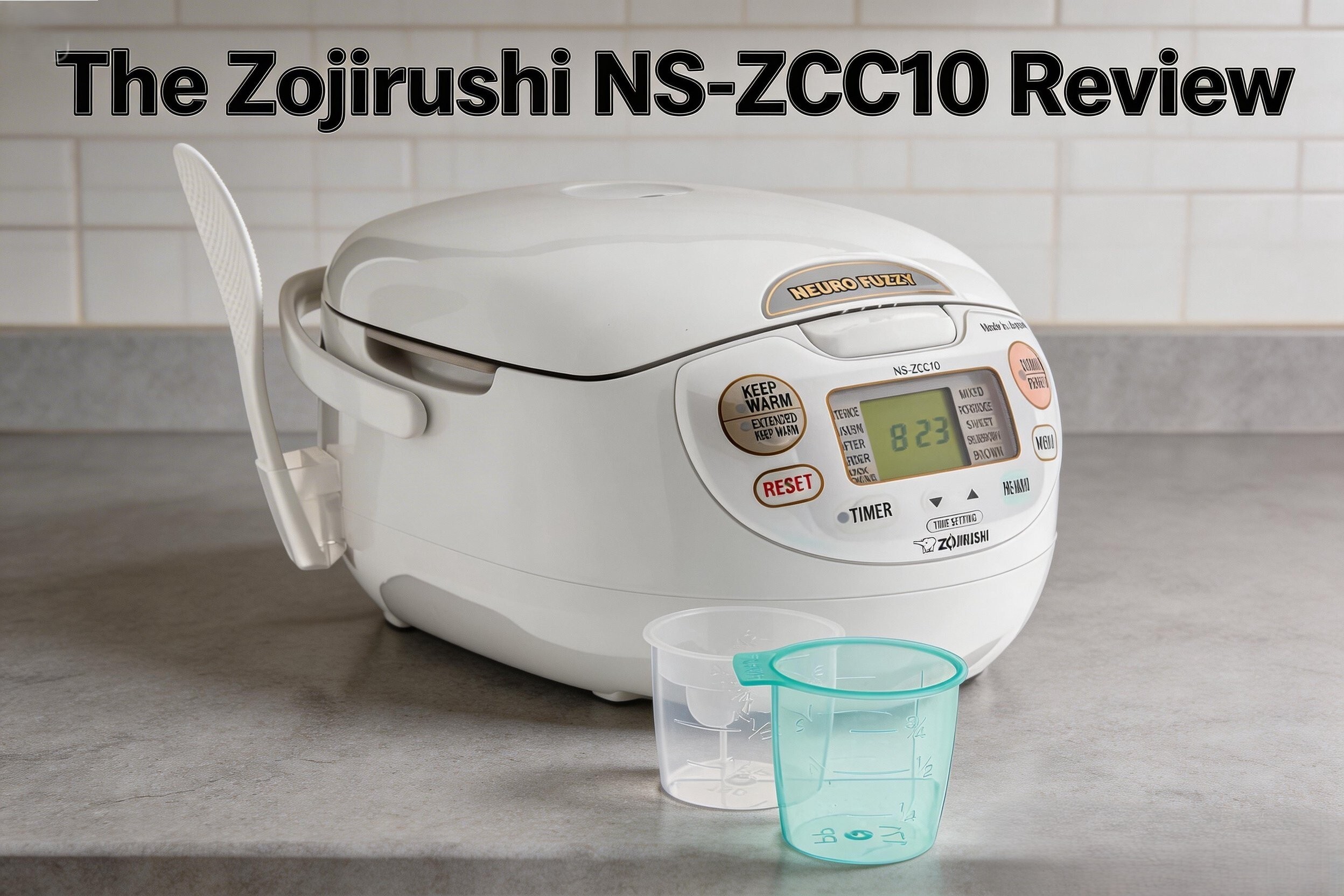
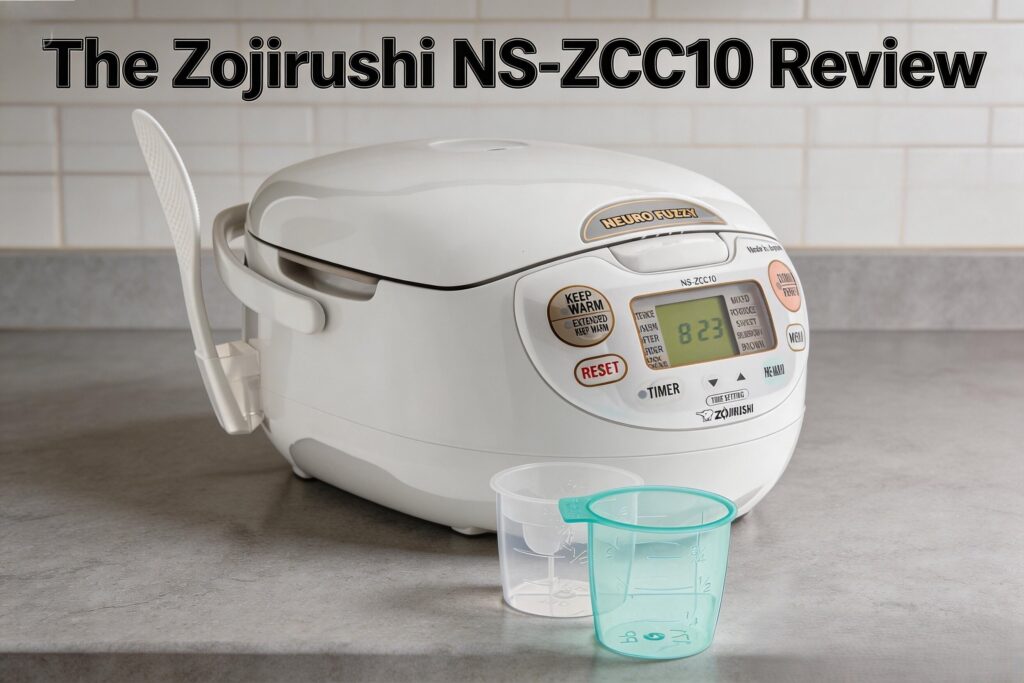
The Zojirushi NS-ZCC10 Review: Would I Buy It Again?
For several Americans, spending $236 on a rice cooker seems like an exercise in excess; for us, using a $20 “on/off” switch aluminum pot cooker found on the bottom shelves of big-box retailers—cookers that produce a layer of scorched rice at the bottom and a plume of starchy water on the counter—is common.
Several years back, I received a Zojirushi rice cooker as a Christmas present. The ease of cooking and excellent rice quality and texture quickly made me obsessed with it. Among these premium appliances, the Zojirushi NS-ZCC10 Neuro Fuzzy rice cooker is arguably the most recognizable ambassador.
In this Zojirushi NS-ZCC 10 review, we will try to cover all those questions that are spinning in your head before giving it a go.
Would I buy it again? (Yes / No / Would buy if)
Let’s decide whether to buy the NS-ZCC10 by reviewing its features, pros, and cons.
Yes:
Buy the Zojirushi NS-ZCC10 if rice is part of your daily diet and you prefer texture over speed.
Another valid reason to buy the Zojirushi NS-ZCC 10 is that it is made in Japan, not in China.
If you want a cooker that keeps rice fresh and ready to serve for over 12 hours, and you cook short- or medium-grain white rice, this is a top-tier investment that delivers restaurant-quality grains every time with “set it and forget it” convenience.
No:
Skip this model if you want a multi-purpose kitchen tool. The NS-ZCC10 lacks a steamer basket and the “Cake” and “Slow Cook” settings found in newer Zojirushi models like the NS-TSC10. Also, skip it if you don’t have 45 to 50 minutes to cook white rice, as the wait can be frustrating. Finally, if you’re budget-conscious, consider avoiding this model.
You can also try other Zojirushi models here: The 10 Best Zojirushi Rice Cookers For 2026 (Reviews, Comparisons & Buyer Guide)
Would buy if:
It’s good to know that this model is designed for superior heat distribution in a spherical inner pan, does not have a modern aesthetic (it looks like some spaceship accessory), and features (like steaming) that make it a dedicated rice-cooker. It serves the purist rather than the generalist.
Zojirushi NS-ZCC10 Key Specs:
- 5.5 cups (uncooked) of capacity.
- Neuro Fuzzy logic (Advanced micro-computerized technology).
- Spherical, non-stick inner pot. It also has stay-cool side handles.
- White (Regular/Sushi, Softer, Harder), Mixed, Porridge, Sweet, Semi-Brown, Brown, Rinse-Free, and Quick Cooking – settings.
- Made in Japan.
- 120V / 680W – power consumption.
What’s great about Zojirushi NS-ZCC10?
Rice Texture and Consistency
Zojirushi provides a good texture with consistency. The NS-ZCC10 prepares perfect rice every time (neither mushy nor undercooked). It has a specific “spring” in the grain that is not found on a stovetop. Because of the triple heating, it manages it so precisely that the texture of both top and bottom rice is the same. So there is no browning / crusting unless a specific setting is used for it.
Neuro Fuzzy Cooking Logic
“Neuro Fuzzy” sounds like something invented by a mad scientist, but it is actually a technology that makes the rice cooker able to micro-adjust automatically during the cooking cycle. In other cookers, the heater stays on until the temperature reaches 212°F or higher.
But in this Neuro Fuzzy system, a microchip monitors temperature throughout the entire process. If you add more water than necessary, the rice cooker extends the “absorption” phase.
Ease of Use
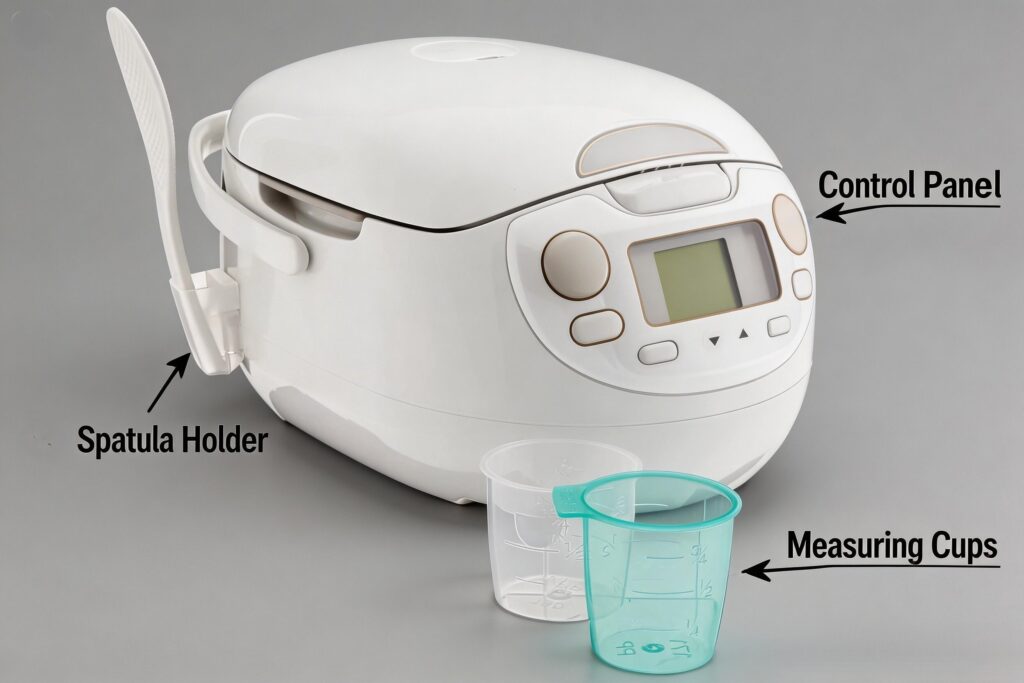
The user interface is remarkably simple. The buttons are large and clearly labeled. The retractable power cord makes it easier to use than cookers with dangling cables. The stay-cool handles on the inner pot make it easy to lift the pot out immediately after the cycle ends.
Reliability
The NS-ZCC10 is a “legacy” appliance. Made in Japan with high-quality components, these units last 15 to 20 years with proper care. This longevity affects how you evaluate the Zojirushi NS-ZCC10’s price: a $180 cooker lasting 15 years equals $12 per year, which is far more economical than replacing a $30 cooker every 2-3 years.
The NS-ZCC10 Shortcomings
Features Vs Price
Not having the steamer basket is a glaring omission for many. Several rice cookers include a plastic tray to steam vegetables or dumplings while the rice cooks. But this model does not include a tray, making it a dedicated rice cooker.
The “Old School” Aesthetic
The NS-ZCC10’s design is iconic but undeniably dated. Its rounded, white plastic “space pod” look has been around for decades. While it’s charmingly retro, a modern kitchen with stainless steel and sharp lines makes it look out of place compared to the sleeker, more industrial-looking induction models.
The Internal Battery Issue
One of the most common complaints about this model involves the internal lithium battery that powers the LCD clock and timer memory. This battery is soldered onto the main circuit board. When it eventually dies (usually after 5–8 years), the clock will go blank when the unit is unplugged. While the cooker still works perfectly when plugged in, replacing the battery requires either shipping the unit to a service center or having advanced DIY soldering skills. For an appliance in this price bracket, a user-replaceable battery would be a much more consumer-friendly design.
Slow Cooking Speed
If you are used to stovetop rice that takes 18 minutes, the Zojirushi will be a culture shock. A standard cycle for white rice takes approximately 50 minutes. To reduce the cooking time, this model has the “Quick” setting, but at the cost of some texture quality. The cooker prioritizes a long soaking and steaming phase, which is essential for the rice’s quality but requires the user to plan dinner well in advance.
The “Wall-Mount” Myth
Is the NS-ZCC10 “wall-mountable”? Do not be fooled. This 7-pound appliance emits significant steam from the top vent. There are no mounting brackets, and you should never attempt to mount this on a wall. It is strictly a countertop appliance.
Real-World Rice Performance
White Rice
This is where the rice cooker earns its keep. Whether you are cooking long-grain American white rice or medium-grain varieties, the results are predictably excellent. The grains are separated, hydrated, and chewy.
Brown Rice
Brown rice is notoriously difficult to cook because of the tough outer bran layer. The NS-ZCC10 features a dedicated ‘Brown Rice’ setting for a longer soaking time, and it automatically adjusts the temperature to ensure the bran is softened while the interior of the grain does not turn into mush. It takes about 80–90 minutes longer, but the result is better than the stovetop.
Sushi Rice
For sushi lovers, the “Sushi” setting is a favorite. Sushi rice demands a very specific balance; it must be sticky enough to hold together, yet firm enough that individual grains retain their shape. The NS-ZCC10 balances it perfectly, making it perfect for home sushi.
Jasmine & Basmati Rice
Zojirushi is primarily designed for Japanese consumers, and rice is a staple in their diet. They mainly consume short and medium-grain rice, and they traditionally like it soft and sticky.
That’s why the NS-ZCC10 cooks rice too soft, or “sticky,” for traditional Japanese tastes when set to the “White” menu option.
Whereas it prepares long-grain rice, such as Basmati or Jasmine, perfectly. To get the best results with Basmati (where grains should be separate and fluffy), use a little less water than the line inside the pot indicates.
Zojirushi NS-ZCC10 vs NS-TSC10: Quick Comparison
| Feature | Zojirushi NS-ZCC10 | Zojirushi NS-TSC10 | Notes / Verdict |
|---|---|---|---|
| Cooking Technology | Neuro Fuzzy logic; spherical inner pan for even heat convection | Standard Micom logic; flat-bottomed pan | NS-ZCC10 provides more precise rice cooking; TSC10 is more basic |
| Versatility | Rice and porridge only | Includes steaming basket, cake baking, and slow cooking | TSC10 wins if you want multi-functionality |
| Build Quality | Made in Japan | Typically made in China | NS-ZCC10 may have better long-term durability and quality control |
These 2 Zojirushi models are 5.5-cup Micom cookers, but they serve different needs.
Verdict: Choose the NS-ZCC10 if you are a rice purist (don’t want to compromise on rice texture) and prefer a “Made in Japan” appliance. Choose the NS-TSC10 if you want a versatile multi-cooker that can also steam vegetables and bake.
To know the other Japan-made rice cookers, you can check: Which Zojirushi Rice Cooker Is Made in Japan?
Is the Zojirushi NS-ZCC10 Worth It? (Price & Value)
The Zojirushi NS-ZCC10 is not a fast-cook or smart appliance with WiFi. You are buying predictability. For several, tension-free cooking is necessary, not “kitchen anxiety.” Zojirushi provides that flexibility; if you put the rice in at 5 pm, it will be perfect at 6 pm, and it will stay perfect until 9 pm (No worries if someone is late for dinner).
The “Extended Keep Warm” feature is another great value add. Without this feature, the rice dries out or turns yellowish after 1-2 hour, but in NS-ZCC10, the moisture levels remain intact during the keep-warm cycle so effectively that the rice remains fresh for 1/2 a day. For families with tight schedules, this price is legit.
Who Should Buy the Zojirushi NS-ZCC10
The Rice Connoisseur
If you can tell the difference between “okay” rice and “perfect” rice, you will appreciate this rice cooker. It is designed for the person who sees rice as the star of the meal, not just a filler.
The Small to Medium Household
The 5.5-cup capacity is the “sweet spot” for couples and families of 4. It can cook as little as half a cup or as much as 5.5 cups (uncooked), making it versatile for daily use.
The Long-Term Investor
If you are tired of the “planned obsolescence” of modern appliances and want to buy a rice cooker that you might still be using in 2040, this is one of the few kitchen electronics that fits that profile.
Who Should NOT Buy This Model
The Spontaneous Cook
If you frequently decide what’s for dinner at 6:15 PM and want to be eating by 6:30 PM, this rice cooker will be a source of stress rather than a help.
The Budget-First Buyer
If you are struggling to justify a $200 appliance, there are $50 to $80 Micom cookers (from brands like Tiger or Hamilton Beach) that will get you 80% of the way to Zojirushi quality for a fraction of the cost.
The Large Family or Entertainer
If you regularly cook for 6 people, and even for large dinner parties, the 5.5-cup model will be too small. You would be better served by the 10-cup (1.8-liter) version of the same cooker, the NS-ZCC18.
FAQs
Is the NS-ZCC10 still worth buying today?
Yes. While it lacks Induction Heating or a steaming basket, its core rice-cooking performance is best in its class. It is a “solved” technology—it does its one job so well that Zojirushi hasn’t found a reason to radically change the design in decades.
Does it make a clicking sound?
Yes. This is a unique trait of this mode. New users get puzzled by the sound at first. But this is very much normal. It is due to its “Fuzzy Logic” adjusting the temperature. The “click” sound it makes every few minutes is due to the relay turning the heating element on and off.
Can I mix my sushi vinegar in the pot?
No. This is discouraged and considered a common mistake. Vinegar is an acid with a pH scale of 2-3.5. And due to the corrosive nature of vinegar, combined with the heat of the bowl, the non-stick coating can be damaged over time. Always transfer the rice to a wooden bowl or a plastic bowl before adding vinegar.
Does Neuro Fuzzy make a real difference?
In a side-by-side comparison with a basic mechanical cooker, the difference is night and day. Compared to a standard Micom cooker, the difference is more subtle, but the Neuro Fuzzy logic is better at compensating for variations in water temperature, room humidity, and slight measurement errors.
Is it good for non-Japanese rice?
It is excellent for American long-grain white rice and brown rice. However, for “fluffy” rices like Basmati, it requires a bit of user adjustment (using slightly less water) to prevent them from becoming too sticky.
Durability of the inner pot
The inner pot is quite heavy and durable, but the non-stick coating is susceptible to scratching. You should never use metal utensils or wash the rice inside the pot using a metal whisk. If you use the included plastic spatula and wash it with a soft sponge, the coating lasts for years. Replacement pots are available but can be expensive.
How does it compare to cheaper rice cookers?
Cheaper cookers use a simple “weight and heat” mechanism. As the water fully evaporates, the pot gets lighter, and the temperature rises, then the switch trips. This causes uneven cooking and results in a crust at the bottom. Whereas the Zojirushi uses a microcomputer to manage heat throughout the cycle, making it more reliable.
Final Thoughts
The Zojirushi NS-ZCC10 has earned a great reputation through decades of its consistent performance.
This model is a dedicated rice cooker, not a multi-tasker. So, when considering the Zojirushi NS-ZCC10 pros and cons, the cons are what the cooker is not aimed at. It isn’t a steamer nor a fast cooker, but it is a reliable, durable, and intelligent rice-cooking specialist; it does better than almost anything else in its price range.
If you are looking for a great rice cooker, the NS-ZCC10 is a classic choice. It may not have the bells and whistles of a multicooker, but it prepares a perfectly cooked, fluffy rice with music each time. Whether it’s sushi rice for a weekend or brown rice for a healthy Tuesday lunch, the NS-ZCC10 prepares the same perfect result, every single time.